Hemp twine has a wide variety of uses, including gardening, making jewelry, and magick (real magick as contrasted wth stage magic).
This web page discusses how hemp twine is made, how it is used, and its history.
A special emphasis is placed on magickal uses, including actual magick spells (see list below). The magick section below includes information on knot magick, magick wands, and real magick spells.
The history section below includes pictures of ancient Egyptian rope making, a copy of the information in Chpater 2 of Jack Herer’s “The Emperor Wears No Clothes”, and the complete pages from Worthington Hooker’s “The Child’s Book of Nature” on Benjamin Franklin’s famous kite experiment using hemp string.
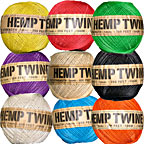
sources of hemp twine Hemp Star Hemp Traders |
| history | magick | jewelry |
| fiber comparison | ||
basics
Hemp rope and hemp twine are spun from the fibers of the hemp or cannabis plant. Hemp fibers are spun into hemp yarns. Hemp yarns are twisted together to make hemp strands (the hemp strands are twisted in the opposite direction of the spin of the hemp yarn). Hemp strands are twisted together to create hemp twine and hemp rope (the hemp rope or twine is twisted in the opposite direction of the twist of the hemp strands) . Hemp twine typically has three plys of hemp strands twisted together.
Hemp twine comes in a variety of thicknesses and may be dyed various colors. Hemp twine may also be polished with paraffin wax.
Hemp twine is inexpensive, but strong and long-lasting. Hemp twine is biodegradable.
You can use thin hemp twine for making jewelry by threading beads and other items onto the twine. Polished hemp twine (polished with wax) is generally used for making jewelry because it is easier to work than fuzzier unpolished or unwaxed twine.
Thicker hemp twine can be used for macrame.
This is a large web page. Jump to history section. Jump to magick section. Jump to jewelry section. Jump to fiber comparison section.
history of hemp twine, rope, and cordage
 this is a huge web page some history topics: | ||
| Ben Franklin kite experiment using hemp string | Celtic knots | Chinese history |
| Egyptian history first rope making machines | Greek history | hand spinning rope |
| Hemp for Victory U.S. government film from World War II | Jack Herer reprinted with permission from The Emperor Wears No Clothes | Japanese history |
| macrame | match locks | Roman history |
| Scythian history first use of horses stringed instruments | Thracians | |
The first known rope and twine dates back 28,000 years Before Present in Europe. Although this early rope and twine no longer exists, it left impressions in fired clay.
Fragments of “two-ply laid rope of about 7 mm diameter” from 15,000 B.C.E. were found fossilized in a cave at Lascaux, France.
Hemp cloth from approximately 8,000 B.C.E. was found at Catal Hüyük (in Anatolia, in modern day Turkey). Cannabis sativa was domesticated in Tibet by 6,000 B.C.E. Hemp was grown in Mesopotamia and Huang He (Yellow River) valley. By 5,500 B.C.E. hemp had spread north through [modern day nations] Russia to Scandanavia, the Baltics, Poland, and Germany, west through the Mediterranean to Egypt, Greece, Italy, Spain, and France, and southeast through China to Japan.
“Virtually every city and town (from time out of mind) in the world had an industry making hemp rope.” —The Emperor Wears No Clothes by Jack Herer
Egyptian rope making
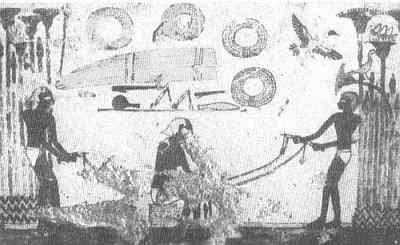
The ancient Egyptians were the first civilization to create rope making tools. Egyptians were making rope and twine by 4,000 B.C.E.. from water reed fibers.
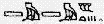
shem-shem-tu sm-sm-t hieroglyphs for cannabis/hemp |
Rope was so important to the ancient Egyptians that it appears early in Egyptian history in six different hieroglyphs (see Egyptian symbols).
 The letter for the sound “ch” (as in “children”) is a picture of a rope hobble used in agriculture to keep animals from wandering away.
 The letter for the sound “h” (as in “he”) is a picture of a piece of twisted hemp rope. This hieroglyph had important magickal and alchemical meaning as the figurative “rope ladder to heaven”. In latter times this hieroglyph was split into two parts. The bottom half became the Roman/Latin letter H and the top half (turned on its side) became the symbol for eternity or infinity.
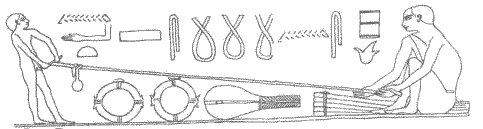
Tomb of Ti
Quibell 1896, Pl.32
By 3,500 B.C.E. the ancient Egyptians were making rope from a variety of natural fibers, including date palms, papyrus, wild reeds, rushes, grass (especially esparto and halfa grass). Flax was used less often. Animal fibers were rare. Camel hair rope dates from the Old Kingdom. Leather was rarely pleated into cordage. Hemp was used for rope and twine making by 2,800 B.C.E.
Exactly when and how hemp and cannabis were introduced into ancient Egypt is still subject to archaeological debate. Cannabis/hemp was commonly grown in ancient Egyptian temple gardens. The use of hemp for non-religious purposes may have been delayed as much as a thousand years from the time of widespread use of hemp for rope throughout the rest of Asia, Africa, and Europe. This may have been because the cannabis plant was reserved for religious and magickal uses, espeically as Ntr Sentra (literally, “the breath of Goddess”) incense. Khufu and Meritites (also spelled Meryetites, Meritates, Merityotes, or Meritates) conducted a ceremony that involved Meritites becoming Seshat incarnate. As Seshat, Goddess of measuring and hemp, Meritates inhaled cannabis smoke and kissed the cannabis breath into the mouth of Khufu, who became Heru (Horus) incarnate.Meritites, still as Seshat in human form, used knotted twine, probably hemp twine, to make the first measurements for the largest of the Great Pyramids, the only surviving of the Seven Wonders of the World.
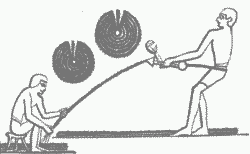
At times a worker would tie the rope around his waist using the weight of his body to keep the rope taught, freeing his hands for manipulating it.
Source: Maude 1862, p.375
The ancient Egyptians were using pulleys in the 4th Dynasty of the Old Kingdom (between 2575 and 2467 B.C.E.).
Ancient Egyptian artwork depicting the manufacture of rope by mechanical means.
Hemp was used for rope and sails as well as fine linens in ancient Egypt. Hemp rope was found in the eighteenth-dynasty tomb of Akhenaten (Amenophis IV) at El Amarna, including a three ply hemp cord in the hole of a stone and a large mat bound with hemp cords.
From the book “The Wonder Book of Knowledge” by Henry Chase, pages 123-124, published in 1921 by The John C. Winston Company, no longer in copyright:
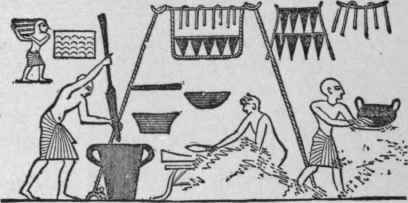
Scene in Egyptian Kitchen, Showing Use of a Large Rope to Support a Sort of Hanging Shelf.All the ancient civilized peoples used ropes and cordage, made from such flexible materials as their countries afforded. We have pictures of this from ancient Egypt, in which the process of twisting strips of leather into rope is shown on the walls of their tombs. One workman is seen cutting a long strand from a hide which he turns round as he cuts, while another man walks backward with this, twisting it as he goes. The Egyptians also made ropes from papyrus and palm fibers, of which specimens still exist. Only by the use of large and strong ropes could they have moved the massive stones seen in their pyramids and temples.
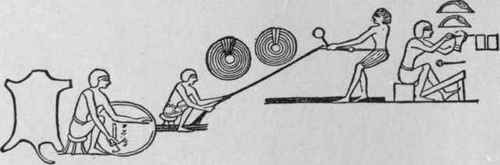
Reproduction of Sculpture from a Tomb in Thebes, Showing Prep ration of Leather Cords by Process Similar to Rope MakingWhen men began to move boats by sails, ropes of some kind must have been needed, and the early ships no doubt demanded long and strong cordage. We have pictures of these from several centuries before the Christian era, and we are told by Herodotus that Xerxes, when he built his famous bridge of boats across the Hellespont, 480 B. C., fastened them together by enormous cables which stretched from shore to shore, a distance of nearly a mile. Twelve of these ropes were used, about nine inches thick, some of them being made of flax and others of papyrus.
Cannabis pollen was found on the mummy of Ramses II (nineteenth dynasty). Initially scholars debated as to whether the cannabis pollen was ancient origin or modern contamination. Additional research showed cannabis pollen in all known royal mummies. No known ancient Egyptian mummies were wrapped in hemp cloth.
The Smoke Eaters at the temple at Thebes used cannabis incense for mortality rituals.
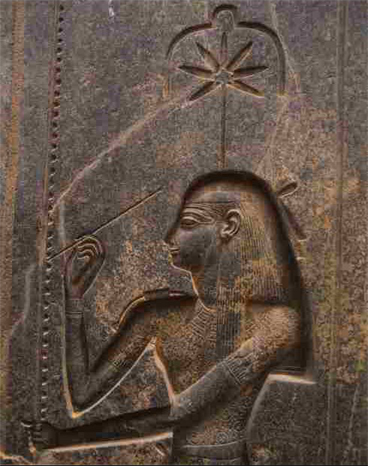
The ancient Egyptian goddess Seshat (above in her role as the Goddess who measures) is depicted with a seven-pointed hemp leaf in her head dress. Pharaoh Tuthmosis III (1479 to 1425 B.C.E.) called her Sefkhet-Abwy (She of the seven points). Hemp was used to make measuring cords. Seshat was the goddess of libraries, knowledge, and geomancy, among other things. Spell 10 of the Coffin text states “Seshat opens the door of heaven for you”.
Twine and rope were used in the construction of the Great Pyramids. There are no written records or surviving physical material to determine what kind of twine and rope. Many commentators argue that the rope had to be made from hemp because of hemp’s superior tensile strength and durability, but history is filled with examples of less than optimum choices.
See also Egyptian symbols.
Chinese history
The Tibetans domesticated Cannais sativa by approximately 6,000 B.C.E., along with heddles for making cloth on looms.
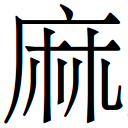
Má is the Mandarin Chinese word for cannabis/hemp. The Chinese character depicts two hemp plants in a covered area.
Hemp was used for textiles in China by 4000 B.C.E.
China was often called “the land of hemp and mulberry”. The mulberry tree was food for the Chinese slikworm.
“Long ago, when these Grecian temples were new, hemp was already old in the service of mankind. For thousands of years, even then, this plant had been grown for cordage and coarse cloth in China and elsewhere in the East.” —from the U.S. gvernment film Hemp for Victory, which urged American farmers to grow hemp for the U.S. navy during World War II.
The Chinese military discovered that hemp string made stronger bowstrings than bamboo fibers, giving the Chinese a significant military advantage. The Chinese emperors set aside large tracts of land to grow hemp for the army.
The Xia Xiao Zheng, the oldest Chinese agricultural book, from approximately 1,600 B.C.E., lists cannabis hemp as one of the main agricultural crops, along with millet, wheat, beans, and rice. By this time the Chinese were using hemp to make scrolls.
In the 2nd century B.C.E. the Chinese developed new techniques for growing, harvesting, and processing hemp.
Shennong (or Shen Nung or Chen Nung), a semi-mythical person who was according to mythology the Chinese Emperor of the Five Grains, is attributed as the author of the Pen Tsao, or The Divine Farmer’s Herb-Root Classic, (compiled during the end of the Western Han Dynasty) classifies cannabis hemp as one of the Superior Elixirs of Immortality.
The first paper was created in China about 100 C.E. by a court eunuch named Ts’ai Lun using a mixture of old hemp rags and mulberry bark.
In ancient China, the rich wore clothing made of silk, while the poor wore clothing made of hemp or ramie. The Mongol invasions of the 1200s destroyed many of the mulberry trees needed for making silk. In the Yuan Dynasty the Mongols introduced cotton to China. The Mongol Emperor Kublai Khan (first emperor of the Yuan Dynasty) opened special traingin centers to teach Chinese farmers how to grow cotton. In 1296 his son, Emperor Temür Öljeytü Khan, ordered lower taxes for farmers who grew cotton.
stringed instruments
From Manual of Guitar Technology: The History and Technology of Plucked String (1981), the English translation of Die Gitarre und ihr Bau (Second Edition, 1972) by Franz Jahnel (translated by J.C. Harvey):
In the Near East silk twine was probably used for strings before silk became well known, however, no such strings have been found preserved anywhere (as for example the gut strings in the Egyptian burial chamber). In Ancient Greece and also in Roman times hemp twine ought to have been in use in addition to gut strings for plucked instruments. Likewise in China and Japan hemp twine has a history going back into antiquity.
Flax-growing in Europe was in progress in the Neolithic Age; in Egypt and Mesopotamia the industry is 4000-5000 years old and flax was probably in use as twine for bow-strings and musical instruments. However, flax is considered too coarse fibred for modern string making in spite of being significantly finer than hemp.
Japanese history
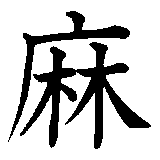
Asa is the Japanese word for cannabis/hemp. The traditional kanji character depicts two hemp plants being dried. After World War II, the Japanese word asa came to also mean jute, sisal, and flax, while the Japanese word taima (created by adding the character for big to the character for hemp), or big hemp, indicates specifically cannabis/hemp.
Cannabis/hemp was grown in Japan from the Neolithic Jomon period. The word Jomon means “pattern of ropes”, a specific reference to hemp’s importance in early Japanese history. By 5,500 B.C.E. hemp had spread southeast through China to Japan. Hemp seeds from Japan’s prehistoric Jomon era were found on the island of Kyushu.
A Jomon era painting from a coastal cave on Japan’s island of Kyushu depicts Korean traders arriving by boat, riding horses, and bringing hemp. The plants have distinctive seven pointed hemp leaves and are surrounded by a sunlike aura, representing the connection between Shinto’s Sun Goddess Amaterasu-O-Mi-Kami and hemp, similar to Sun deuty and hemp connections in carvings from Mediterranean cultures.
The Japanese made coins of gold (oban, koban, ichiby kin), silver (chogin, mame-ita, monme), copper (zeni), and iron. The coins had square holes in the center and were carried on hemp strings. The modern Japanese five (5) yen coins still have this hole.
During the Yayoi period (500 B.C.E. to 300 C.E.) clothing was made from hemp and bark, a technique used in Japan for hundreds of years. Hemp had definitely spread throughout Japan. On the northern island of Hokkaido the indigenous Ainu people made colorful clothing from hemp fiber.
A Buddhist Monk from Korea named Doncho introduced paper made from hemp rags and mulberry bark (in the Chinese paper-making tradition) around 610 C.E. Within 50 years the use of paper was widespread throughout Japan, in large part because hemp was already in widespread use in Japan for rope, twine, and cloth.
Silk (for the wealthy Samurai) and hemp (for the peasants) were the two primary clothing fibers in Japan until the 1700s. Even after the introduction of cotton, hemp was the primary fiber for the straps of geta (high wooden sandals), for the long fishing lines for catching eels, and for packaging ropes and twine.
The Japanese battleship Yamato and its sister ship Musashi were the two largest battleships ever built in human history. Prior to World War II the Japanese imperial government kept the construction of the ships secret by building them under massive blinds made of hemp rope.
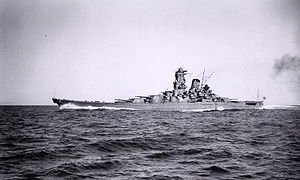
HIJMS Yamato running full-power trials in Sukumo Bay, 1941
The Musashi was built at Mitsubishi’s shipyard in Nagasaki, Japan. The hemp rope blinds were so successful that the American Consulate located across the bay never suspected the ship was being built! The Musashi was launched 1 November 1940.
The Yamato was built at the Kure Naval Arsenal in Hiroshima, Japan, using a hemp rope blind to hide the ship’s characteristics. The Yamato was launched on 8 August 1940.
Celtic knots
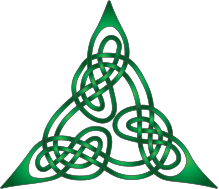
Celtic knots appear in every society where the Celtic people at one time lived (from Ireland to the western desert border of China). The classic triquetra is shown to the right. The use of interlaced knots appears in Roman mosiacs of the Late Classical Period, which in turn influenced the use in Coptic, Islamic, Ethiopian, Medieval Russian, and European art and architecture.
The word triquerta comes from the Latin tri- (“three”) and quetrus (“cornered”), originally meaning triangle, but later specifically meaning three cornered knotted rope designs.
The triquerta appears in ancient Germanic runestones and coins, where it is associated with the Valknut, a symbol of Odin.
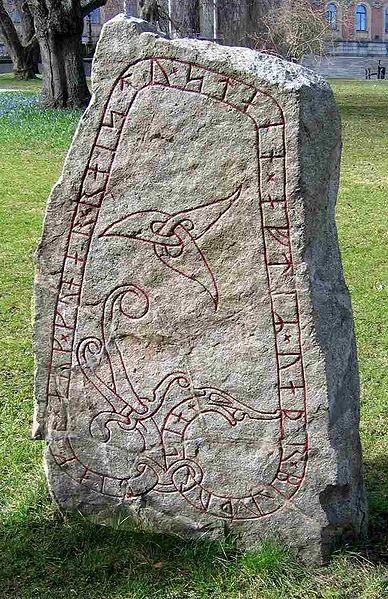
Runestone standing in the University Park of Uppsala in Sweden.
See also the section on the magickal uses of Celtic knots.
Scythians and horses
The Scythians were a cannabis/hemp using and horse riding society.
Among the uses of hemp rope with tack for horses are: lead ropes, hobbles, halters and brodles, reins, rope to tie saddles, tie-downs, neck ropes, and even bedding material for horses and hemp rope bits. For a modern version of hemp bedding for horses, see HemCore.
The Scythians (as the Greeks named them) or Sakas (as the Persians named them) were the first people to domesticate the horse. Originally from the same area as the Persians and other Iranian peoples, Scythian mounted archers terrorized Eurasian plains, including Eastern Europe, the Mediterranean, Central Asia, Russia, Kazykstan, and the Ukraine from the seventh to first centuries B.C.E. Their society used hemp for rope (including the gear for their famous horses) and cannabis for medicine and religion.
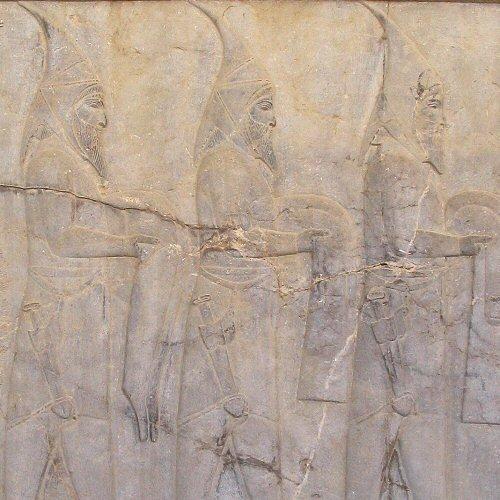
Sakâ tigrakhaudâ. Relief from the eastern stairs of the Apadana at Persepolis
Chris Bennet claims that the Scythians spread the spiritual and practical knowledge of cannabis/hemp (including hemp ropes and twine). Herodotus wrote: “Now they have hemp growing in their land, which is very like flax except in thickness and in height, for in these respects the hemp is much superior. This grows both of itself and with cultivation;”
The Scythians fought as mounted archers. The Scyhtians were famous for their female warriors and are most likely the source of the Greek legends of Amazons. Herodotus wrote: “No Scythian woman may marry until she has killed a man of the enemy.” In the late 20th Century archaeolgists found tombs of Scythian women buried in riding clothes along with their jewelry, bows, swords, and horses. The horses buried in the graves were of the Yabou-type and rarely a thoroughbred. When a thoroughbred was buried, it was old or lame. This was because of the high value of thoroughbred.
As part of their burial rituals, the Scythians built a small teepee-like structures made of felt, leather, or hemp cloth and inhaled cannabis fumes from seeds and resinous flower calyxes thrown onto red hot stones. Herodotus wrote: “The Scythians then take the seed of this hemp and creep under the felt coverings, and then they throw the seed upon the stones which have been heated red-hot: and it burns like incense and produces a vapour so think that no vapour-bath in Hellas would surpass it: and the Scythians being delighted with the vapour-bath howl like wolves.”
In 1929 Professor S. I. Rudenko discovered a Scythian tomb in Pazyryk, Western Altai, near the border of Siberia and Mongolia. Several additional tombs were found in the sacred burial grounds of the Pazyryk and Altai Mountains. The burial sites included shirts made of hemp fiber, bronze cauldron filled with burnt hemp seeds and hemp resin residues, and metalic censors that were used for smoking cannabis.
A 1994 archaeological dig at Ukok in the Altai mountains of Siberia near the borders of Russia, China, Mongolia, and Kazakhstan, revealed a 2,000-year-old mummy of a Scythian queen buried in white silk alongside horse harnesses, a mirror, dishes, and a small ceremonial container of cannabis.
Archaeology in the sacred burial grounds of the Pazyryk and Altai Mountains was banned out of respect for the spirits of the ancestoral dead.
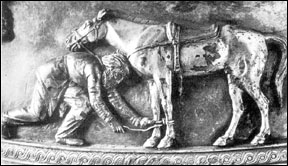
Image on a Scythian bowl found in the Chertormlyk region from approximately the 4th Century B.C.E. depicting a Scythian applying hobbles to a saddled Yabou-type horse.
Notice the Kemetic (ancient Egyptian) letter for the sound “ch” (as in “children”) is a picture of a rope hobble used in agriculture to keep animals from wandering away.
The Encyclopedia Britannica states: “The Scythian’s horses were also outfitted in beautiful and ornate costumes, and were seen ridden for the first time among many of the peoples they descended upon.”
There are surprising similiarities between the artwork of the Minoan-Mycenaean and Scytho-Siberian cultures, even though the two cultures were seperated by a great distance and more than five centuries. There is no evidence of any physical connection or successor role between the cultures, including a lack of stone work that would have certainly survived had their been a connection.
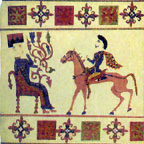
One of two rugs found in the tombs had a repeating image of a Scythian horseman approaching the great Goddess Tabiti-Hestia, the only deity depicted in Scythian artwork. Tabiti-Hestia is depicted holding the Tree of Life in one hand and raising the other hand in a gesture of welcome. As Goddess of fire and beasts, the Greeks associated Tabiti-Hestia with their own Artemis, Hestia, and Gaea (Mother Earth). The Greeks also associated Artemis with the Kemetic (ancient Egyptian) Goddess Bast.
The Scythians had shamanic magicians called the Enaries who were transvestites. The Enaries smoked cannabis and made prophecies in high pitched voices. The Scythians believed that by having characteristics of both sexes the Enaries were able to easily travel between the physical and spiritual worlds.
At their height, the Scythians conquered Syria and Judea in 625 B.C.E., and took control of half of Persia, as well as threatening even Egypt. The Scythians and Egyptians agreed to a peace treaty. The Scythians played an important role in the fall of the Assyrian empire.
Thracians
Herodotus wrote of the Thracian use of hemp fibers in clothing: “Hemp grows in Scythia: it is very like flax; only that it is a much coarser and taller plant: some grows wild about the country, some is produced by cultivation: the Thracians make garments of it which closely resemble linen; so much so, indeed, that if a person has never seen hemp he is sure to think they are linen, and if he has, unless he is very experienced in such matters, he will not know of which material they are.”
Greek history
“The Swallow and the Other Birds”:from Aesop’s ancient Greek book Aesop’s Fables:
It happened that a Countryman was sowing some hemp seeds in a field where a Swallow and some other birds were hopping about picking up their food. “Beware of that man,” quoth the Swallow. “Why, what is he doing?” said the others. “That is hemp seed he is sowing; be careful to pick up every one of the seeds, or else you will repent it.” The birds paid no heed to the Swallow’s words, and by and by the hemp grew up and was made into cord, and of the cords nets were made, and many a bird that had despised the Swallow’s advice was caught in nets made out of that very hemp. “What did I tell you?” said the Swallow.
Roman history
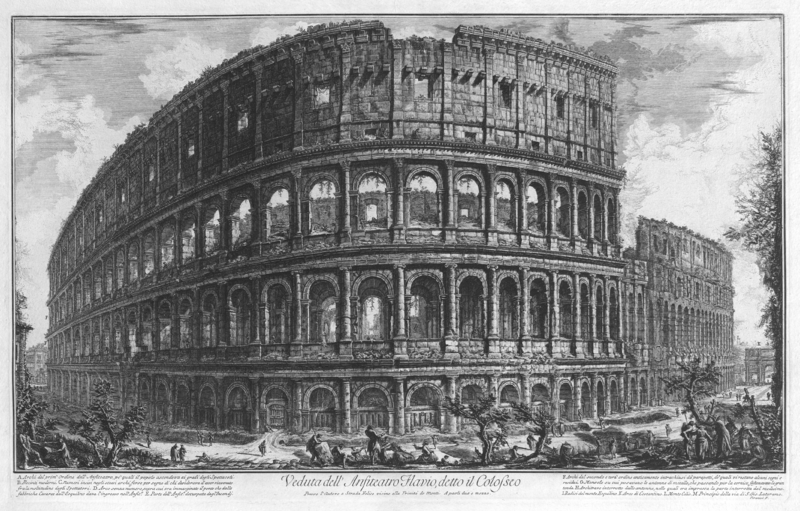
Giovanni Battista Piranesi’s 1757 drawing of the Roman Colosseum
The Roman Colosseum or Flavian Amphitheater had a rigging with hemp ropes to provide a sun shade for the audience. The Roman Colosseum was named for the colossal statue of Apollo at the entrance.
Roman Emperor Vesparian ordered the start of construction between 70 and 72 C.E.. Work was completed in 80 C.E. under Roman Emperor Titus. Both were members of the Flavis family, hence the original name Amphitheatrum Flavium.
The massive intricate system of hemp ropes and sunscreen awnings operated by sailors from the Roman navy stationed at Roman navy headquarters at Misenum.
The sunscreen awnings at the Roman Colosseum were called the Velarium. Around the top of the Colosseum (above the maenium summum in ligneis) were 240 mast corbels, or brackets projecting from the face of the wall, which supported the Velarium (the sockets are still visible). The sunscreen awnings were made of hemp, flax, or cotton. The wooden masts was made of fir or pine. The rigging was susspended like the sprit of a Roman sprit-sali rig. The brails (awnings furling lines) were like Roman square-sail rig. The Roman sailors worked the rigging from a platform around the Colosseum’s top edge.
Hempen ropes were found in a well at a Roman fort (occupied from 140 to 180 C.E.) located in what is now Dubartonshire, Great Britain. England did not have its own hemp industry until around 400 C.E. when the Angles, Saxons, and Jutes invaded and brought hemp seeds with them. The Roman army sent hemp to its fortifications throughout the Roman Empire as a standard military supply.
matchlocks
Matchlock guns of the 1400s through 1700s were fired using a slow match made from twisted hemp cordage. The Japanese instead used braided bark from the Japanese cypress tree. The hemp cord matchlock was used to fire muskets, cannons, and petards. Matchlock guns started disappearing from use around 1630 with the invention of the flintlock. By 1730 both the British and French armies has converted to flintlock weapons.The Japanese stopped using matchlock weapons in the early 1900s.
The hemp cord slow match was typically 7/16" to 1/2" (half inch) in diameter. While usually twisted hemp cord, the slow match was also made from braided hemp cordage. The slow match hemp cord was chemically treated, usually with potassium nitrate, but also other chemicals including sodium nitrate or lead acetate.
Nathaniel Nye wrote in Art of Gunnery in 1647 “Take cords of hemp that’s not very fine, or of toe, which is better, although it will sooner consume, and let every cord be as big as a mans little finger, this done, boil the cords in strong lye, ashes and a little salt peter till all the lye be wasted, then dry.”
hand spinning rope
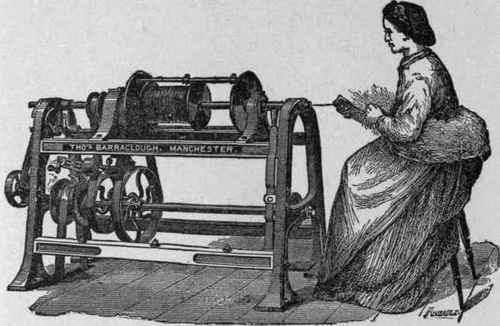
Early Type of Machine for Spinning Rope Yarn.During the medieval and later centuries rope making was an active industry and America was not long settled before the rope maker became active. John Harrison, an English expert in this line, set up a ropewalk in Boston in 1641 or 1642, and for many years had a monopoly of the trade. But after his death the art became common and in 1794 there were fourteen large rope walks in that city. In 1810 there were 173 of these industries in the United States, and from that time on the business has grown and prospered.
Hand Spinning.
In the period referred to all the work was done by hand, machine spinning being of later date. American hemp was used, this softer fiber being spun by hand long after Manila hemp was spun by machines. The hand-making process, long used, is an interesting one. The first step was to “hackle“ the hemp. The hackle was a board with long, sharp steel teeth set in it. This combed out the matted tow of the hemp into clean, straight fiber. The instrument used in spinning was a large wheel turned by hand, and setting in motion a set of “whirls” or revolving spindles, which twisted the hemp by their motion. The spinner wrapped a quantity of the hackled hemp around his waist and attached some of the fibers to the whirls, which twisted the hemp as he walked backward down the ropewalk, pulling out new fiber from his waist by one hand and pressing it into form and size with the fingers of the other. In forming a small rope, two of the yarns thus formed were twisted together in a direction opposite to that of the first twist. Then a second twisting followed, the direction being again reversed. Thus rope making may be seen to consist in a series of twisting processes, each twist opposite to the former, the rope growing in size and strength at each operation. Horse power or water power was used when the ropes became too large to be made by hand.
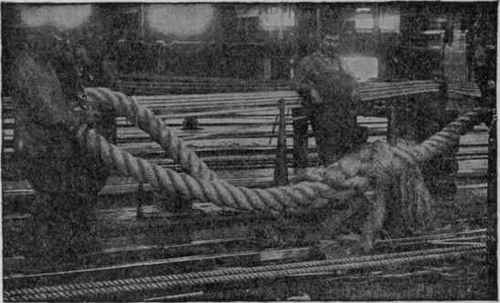
Sixteen-Inch Towline with Eye Splice.
Ben Franklin
Ben Franklin used hemp twine for his famous kite electricity experiment.
From the book "The Child’s Book of Nature" by Worthington Hooker (1806-1867), pages 179-181, published in 1886 by American Book Co., New York, no longer in copyright:
Silk, I have told you, is one of the non-conductors. Dr. Franklin made use of silk in the experiment by which he discovered that lightning and electricity are the same thing. He managed in this way : He made his kite of a large silk handkerchief instead of paper. He had on it a pointed iron wire, and the string of the kite was fastened to this wire. This kite he sent up in a thunder-storm, when there was plenty of electricity in the clouds. The iron wire would, of course, receive some of the electricity, and it would not go from the wire to the kite, because that was made of silk, which, you know, is a non-conductor. It would go down the string, this being tied to the wire. Passing down the string, it would go to Dr. Franklin’s hand, and down his body into the earth. It would do this silently, because it would keep going a little at a time all the while. But he managed to prevent the electricity from coming to his hand. He stopped it on the way. He did this by tying a silk ribbon to the hemp string, and holding the kite by this ribbon, as you see in the picture. The electricity could not go through this silk, and so it stayed in the hemp string.
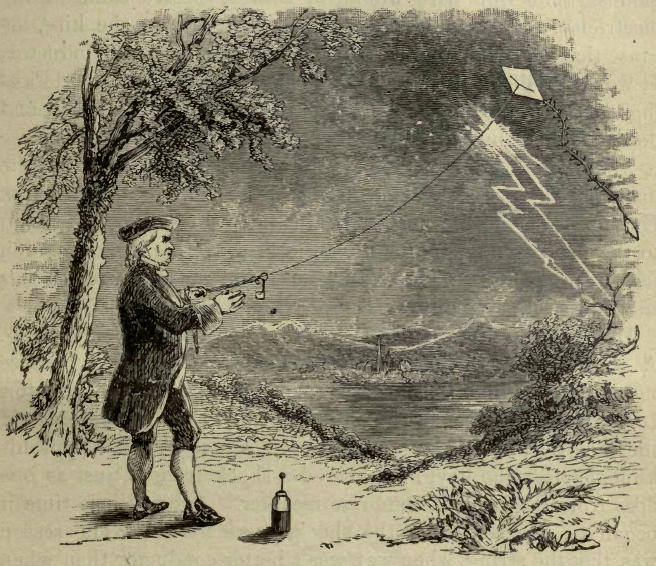
Dr. Franklin now fastened a key to the end of the hemp string. A great deal of the electricity now passed to the key, because the metal of which the key was made was so good a conductor. It was a real receiver of the electricity, like the brass receiver of the electrical machine. Accordingly, when Franklin put his knuckle near the key, he received a shock from it, just as one does from the knob of the brass receiver. After a little time it began to rain, and then the shocks were harder. The reason was, that the string, when wet, was a better conductor than when dry, and so the electricity came on it faster to the key.
In this way Dr. Franklin drew the lightning down from the clouds in so small a quantity that he could find out what it was.
He found that it was just the same as the electricity that we make by the electrical machine, and he could collect it in the same way that we do the electricity from the brass receiver. This he could do by holding the Leyden jar with its brass knob to the key. The electricity would pass to it just as it does from the receiver when we are working the machine.
Before Franklin tried this experiment with his kite it was supposed that the lightning was electricity, but it. was only supposition. No one knew that it was so. It was never proved till Franklin sent up his silk kite to find out about it. It was supposed that lightning was electricity simply because the effects of lightning were similar to the effects of the electricity of the machine, when a great deal of this electricity was made. Experiments were tried which showed that the machine electricity, when there was enough of it, tore things to pieces, and killed animals, just as lightning does; but the difficulty was that no one had ever seen what a little of the lightning would do. This Franklin found out by bringing some of it down out of the clouds by the string of his kite, for use in the Leyden jar.
It was these experiments of Dr. Franklin that suggested the use of lightning-rods.
from Jack Herer’s
The Emperor Wears No Clothes
reprinted with Permission from Chapter 2 of Jack Herer’s famous The Emperor Wears No Clothes
|
|



reprinted with Permission from Chapter 2 of Jack Herer’s famous The Emperor Wears No Clothes
Jack Herer died 15 April 2010. He was a good man and a good friend.
Jack Herer
Rest in Peace
Jack Herer, one of the leaders of the hemp/cannabis/marijuana relegalization movement, died Thursday, April 15, 2010, in Eugene Oregon. Jack was a good man and a good friend.
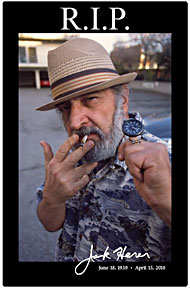
Jack Herer was the author of The Emperor Wears No Clothes: The Authoritative Historical Record of Cannabis and the Conspiracy Against Marijuana (16 different updated printings), the leading book on the uses and history of hemp/cannabis and marijuana prohibition. I got to know Jack because I created the CD-ROM version of his book (three published versions, and one unpublished).
Jack Herer spoke about how he and Captain Ed Adair had promised to work on hemp/cannabis/marijuana relegalization until they succeeded or they were 84. Jack died at 70 years old. Now it is our turn to take up his life-long efforts on behalf of all of humanity. His widow, Jeannie, is collecting signatures for the California state initiative that Jack Herer wrote.
Consider Jack Herer’s $100,000 challenge (prove this statement wrong and you get $100,000): “If all fossil fuels and their derivatives, as well as trees for paper and construction, were banned in order to save the planet, reverse the Greenhouse Effect and stop deforestation; then there is only one known annually renewable natural resource that is capable of providing the overall majority of the world’s paper and textiles; meet all of the world’s transportation, industrial and home energy needs, while simultaneously reducing pollution, rebuilding the soil and cleaning the atmosphere all at the same time … and that substance is the same one that has done it before … CANNABIS HEMP!”
Jack Herer was born June 18, 1939, in New York City. He suffered a heart attack backstage on Saturday, September 12, 2009, at the Hempstalk 2009 in Portland, Oregon. He died Thursday, April 15, 2010, in Eugene Oregon of complications from that heart attack.
Jack Herer had a gruff manner, but he was focused on legalizing cannabis/hemp. He travelled the world researching the uses of hemp and proclaiming the need for legalization.
Hemp for Victory
Hemp for Victory was a U.S. government film made in World War II to encourage American farmers to grow hemp for the war effort. The following is a partial trasncript from the movie:
Long ago, when these Grecian temples were new, hemp was already old in the service of mankind. For thousands of years, even then, this plant had been grown for cordage and coarse cloth in China and elsewhere in the East. For centuries prior to about 1850 all the ships that sailed the western seas were rigged with hempen rope and sails. For the sailor, no less than the hangman, hemp was indispensable.
A 44 gun frigate like our cherished Old Ironsides took over 60 tons of hemp for rigging, including an anchor cable 25 inches in circumference. The Conestoga wagons and prairie schooners of pioneer days were covered with hemp canvas. Indeed, the very word canvas comes from the Arabic word for hemp. In those days hemp was an important crop in Kentucky and Missouri. Then came cheaper imported fibers for cordage, like jute, sisal and manila hemp, and the culture of hemp in America declined.
But now with Philippine and East Indian sources of hemp in the hands of the Japanese, and shipment of jute from India curtailed. American hemp must meet the needs of our Army and Navy as well as our industry. In 1942, patriotic farmers at the government’s request planted 36,000 acres of seed hemp, an increase of several thousand percent. The goal for 1943 is 50,000 acres of seed hemp.
In Kentucky much of the seed hemp acreage is on river bottom land such as this along the Kentucky River gorge. Some of these fields are inaccessible except by boat. Thus plans are afoot for a great expansion of a hemp industry as a part of the war program. This film is designed to tell farmers how to handle this ancient crop now little known outside Kentucky and Wisconsin.
This is a large web page. Jump to history section. Jump to magick section. Jump to jewelry section. Jump to fiber comparison section.
fiber comparison
There are three basic kinds of plant fibers: stem (bast) fibers (dicots), leaf fibers (monocots), and seed fibers (dicots and monocots).
Hemp is a very soft, long lasting, and strong natural fiber. Hemp is the strongest natural plant fiber. Hemp resists salt water and mildew. Hemp twine comes from the Cannabis sativa or Cannabis indica plants, or other cannabis species. Hemp can be used to make cloth softer and more luxurious than cotton or silk. Indian hemp or true hemp (Cannabis sativa) is a stem or bast fiber of the Cannabaceae or Marijuana family (which only includes hemp and hops). Earlier botanical classifications placed cannabis/hemp into the Urticaceae or Nettle family or the Moraceae or Fig or Mulberry family.
Hemp has been used for twine and cloth for at least 10,000 years. Hemp cloth from approximately 8,000 B.C.E. was found at Catal Hüyük (in Anatolia, in modern day Turkey). Cannabis sativa was domesticated in Tibet by 6,000 B.C.E. Hemp was grown in Mesopotamia and Huang He (Yellow River) valley. By 5,500 B.C.E. hemp had spread north through [modern day nations] Russia to Scandanavia, the Baltics, Poland, and Germany, west through the Mediterranean to Egypt, Greece, Italy, Spain, and France, and southeast through China to Japan.
Manila hemp or Abaca twine is good for general outdoor use. Abaca (Musa textilis) is a leaf fiber of the Musaceae or Banana family.
Manilla rope and twine is brown when new and over up to ten (10) years of usefulness turns a brownish gray.
Sisal twine is good for outdoor use and also great for cat toys and scratching posts. Sisal can stretch, is durable, and can resist salt water. Sisal comes from the Agave sisalina plant, a relative of the blue agave (Agave tequilana) plant used to make tequila. Sisal has been grown commercially since the 1930s. Sisal can be used to make cloth softer and more luxurious than cotton. Sisal (Agave sisalana) is a leaf fiber of the Agavaceae or Agave family.
Sisal rope and twine is bleached blonde when new, but rather quickly discolors into a dirty light borwn-gray.
Coir (coconut) twine is light weight and floats. Coir (Cocos nucifera) is a seed fiber of the Arecaceae or Palm family.
Flax twine is very soft. Flax (Linum usitatissimum) is a stem or bast fiber of the Linaceae or Flax family.
Cotton twine is soft. Cotton (Gossypium hirsutum, Gossypium arboreum, Gossypium herbaceum, or Gossypium barbadense) is a seed fiber of the Malcaceae or Mallow family.
Cotton twine is soft and durable. The use of cotton dates back to about 3000 B.C.E. in the Indus River valley in what is now modern Pakistan and in the Nile River valley in what is now modern Egypt.
Jute twine is common for outdoor garden use. Jute (Corchorus capsularis) is a stem or bast fiber of the Tiliaceae or Basswood family.
Ramie twine. Ramie (Boehmeria nivea) is a stem or bast fiber of the Urticaceae or Nettle family.
Kenaf twine. Kenad (Hibiscus cannabinus) is a stem or bast fiber of the Malvaceae or Mallow family.
Wool twineis made from the hair of animals, primarily sheep, goat, angora goat, angora rabbit, and camel. Wool is warm, soft, strong, and resistant to dirt and wear. Wool twine was first used about 12,000 years ago.
Silk twine is made from the cocoon of the silkworm.
Silk was discovered by Chinese Empress Hsi Ling Shi in 2640 B.C.E.
Natural fibers do not change color under UV light (such as the sun).
| tensile strength of fibers | ||||
|---|---|---|---|---|
| material | breaking length km | Specific Gravity of fiber | Tensile strength of fiber N/mm2 | Tensile strength as string core N/mm2 |
| horse hair | 11 | 1.3 | 140 | |
| wool | 10-15 | 1.32 | 129-194 | 102-152 |
| silk | 30-42 | 1.27-1.37 | 364-564 | 285-442 |
| cotton | 20-40 | 1.47-1.52 | 286-595 | 227-466 |
| flax | 35-54 | 1.40-1.49 | 481-785 | 378-617 |
| hemp | 35-54 | 1.40-1.49 | 481-785 | 378-617 |
making rope and twine
Rope and twine can be made either by twisting fibers together or by braiding fibers together. Leather rope is typically braided. Plant fibers are typically twisted.
Rope and twine are spun from animal or plant fibers. Fibers are spun into yarns. Yarns are twisted together to make strands (the strands are twisted in the opposite direction of the spin of the yarn). Strands are twisted together to create twine and rope (the rope or twine is twisted in the opposite direction of the twist of the strands) . Twine typically has three plys of strands twisted together.
Twisted rope is often called “laid rope”. Rope that is twisted from four strands is called “shroud laid”. Rope made from natural fibers is called “real rope” or “old-fashioned rope”.
treatments
Twine used for craftwork is often coated with wax because natural fibers, such as hemp, cotton, flax, and jute, grip better and are easier to work with when waxed.
Hemp twine is polished with paraffin wax. Polished hemp twine is generally used for making jewelry because it is easier to work than fuzzier unpolished or unwaxed twine.
Cotton, flax, hemp, jute, silk, and sisal are available uncoated.
Hemp sailing rope was impregnated with tar to make the rope easier to tie into knots. Hemp whaling lines were slightly vaporized with tar to prevent stiffening, allowing the close coiling essential for harpooning whales. Tar does not increase strength or durability (in salt water or fresh water environments).
sailing
Bitter end: is the free end of a line (rope).
Standing part: is the longer part of a line (rope) during the tying of a knot.
garden
Hemp twine can be used to stake plants in your garden, including Witch gardens.
Organic hemp is grown without herbicides, pesticides, or insecticides and is therefore safe for gardening.
Hemp twine can be used as a guide to create straight rows when planting your garden. Drive a stake into the ground at each end of the row and string the hemp twine from one stake to another. Use the hemp twine as a guideline to make a straight row while planting.
Hemp twine can be used as a guide to create straight rows when planting your garden. Drive a stake into the ground at each end of the row and string the hemp twine from one stake to another. Use the hemp twine as a guideline to make a straight row while planting.
Hemp twine can be used to train vines and climbing plants, or to secure and train other plants, such as roses. Tie plants to trestles, stakes, bamboo supports, and other growing guides. Hemp is one of the softer natural fibers, although In the case of particularly delicate plants you may want to use softer hemp yarn instead.
Some gardeners use green hemp twine so that the twine blends in with the green of the plant, making the guide twine “invisible”. Natural green hemp gardening twine is unobtrusive, non-toxic, and biodegradable.
Hemp twine can be used to bunch fresh-cut flowers or herbs for drying.
Hemp twine can be used to bundle firewood.
macramé
Macramé or macrame is the art of creating decorative fringe or lace from rope or twine knotted in geometric designs.
The word “macramé” is from the Arabic word for embroidered veil. The Arabic words miqrama (meaning coverlet) and migramah (meaning veil or embroidered veil) were the source of the Turkish word makrama (meaning napkin or towel) which in turn was the source of the Italian word macramè and the French word macramé both of which were the sources of the English word macramé or macrame. The word appears to enter the English language between 1865 and 1869.
Hemp is the best twine, cord, or rope for macramé because it holds its shape well.
Arabic weavers developed macramé in the Thriteenth Century (13th century) by knotting the excess cloth at the edges of loomed fabric.
In the Fourteen and Fifteenth Centuries (14th and 15th centuries) French and Italian sailors picked up macramé as a way to pass time. Macramé was used to make both small pieces of artwork and to make practical items for shipboard use.
Instructions for making the basic macramé knots are listed in the jewelry section
butterfly feeder
Suspend a small ceramic or glass plate (or terra cotta plant dish) with either flower pot hangers or macrame holder made from twine (especially hemp twine). Optionally wrap plastic or silk flowers in the twine to make the feeder visually appealing to butterflies.
Hang the butterfly feeder from a shade tree. The height should be a little higher than flower level from the ground.
Put over ripe, mushy, and too soft fruit into the butterfly feeder. Butterflies prefer mushy, over ripe fruit.
Replace the fruit if it becomes dried or moldy.
Watch the butterflies.
This is a large web page. Jump to history section. Jump to magick section. Jump to jewelry section. Jump to fiber comparison section.
magick
magic
Hemp twine has the same general magickal properties as clear quartz and can therefore be used in the working of any kind of magick.
The word “magick” indicates real magick (such as Witchcraft and Wicca), in contrast with stage magic and sleight of hand (prestidigitation, meaning “quiick fingers”, or légère de main, from the French for “lightness of hand”).
magick knots
There are many magick spells and magick rituals that involve tying magick knots.
Some of these magick spells involve speaking or blowing breath onto or over the knots.
Islam and the Koran refer to Witchcraft primarily with the phrase “blowing on knots”. Islam considers blowing on knots a death penalty offense.
- magick spells list (on this page)
- magick spells
- traditional nine knot spell
- New Year’s Day Magick
- string love spell
- finding a job
- bind from harm
- healing knots
- love binding spell
- releasing hate or anger
- protection
- rid of troubles
- safe travel
- letting go
- cutting pain
magick properties
Hemp twine has the same general magickal properties as clear quartz and can therefore be used in the working of any kind of magick.
Planetary Rulers: Venus, Jupiter, Saturn, Neptune
Astrological Signs: Gemini, Capricorn
Elements: Earth, Water
Numerology: 2, 5, 6, 7
Goddesses: Amaterasu, Aset/Isis, Bast/Bastet, Freyja, Hani-Yasu-No-Kami, Indra, Mati-Syra-Zemlya, Vesta/Hestia, Venus
Deities: Asar/Osiris, Dionysus/Bacchus, Fimbul/Fimbulltyr, Pan, Priapus, Rupintojelis/Vaizgamtas, Shiva, Vaithgantas
Animal associations: goat, ass (donkey) — from Aleister Crowley’s Magick in Theory and Practice
Plant associations: Indian hemp, orchis root, thistle — from Aleister Crowley’s Magick in Theory and Practice
Kemetic magick symbols
ancient Egyptian magic symbols
Rope was so important to the ancient Egyptians that it appears early in Egyptian history in six different hieroglyphs. The hieroglyphs (from Greek) were called Medu Neter in the native Egyptian language. Both Medu Neter and hieroglyph mean “divine writing” or “holy wiriting” or “sacred writing”. The ancient Egyptians believed that the Goddess Seshat (Goddess of creativity and cannabis/hemp) created the original hieroglyphs and that either Isis (Aset) (Goddess of civilization) or Dejuhti (Thoth) (deity of knowledge) brought them to humanity.
The hieroglyph for hemp rope hobble or tether (ch in Kemetic or ancient Egyptian) is V13 and V14 from the Gardiner sign list. The letter for the sound “ch” (as in “children”) is a picture of a rope hobble used in agriculture to keep animals from wandering away.
The hieroglyph for twisted hemp rope The hieroglyph for twisted hemp rope or hemp twine, such as a wick, (h in Kemetic or ancient Egyptian) is V28 from the Gardiner sign list. The letter for the sound “h” (as in “he”) is a picture of a piece of twisted hemp rope. This hieroglyph had important magickal and alchemical meaning as the figurative “rope ladder to heaven”. In latter times this hieroglyph was split into two parts. The bottom half became the Roman/Latin letter H and the top half (turned on its side) became the symbol for eternity or infinity (∞).
shenu
shen ring
 The hieroglyph for shen ring (shenu in Kemetic or ancient Egyptian) is V9 from the Gardiner sign list. The word shenu means encircle. The earliest surviving use of the shen ring is in reliefs on the step pyramid of Djoser from the Third Dynasty.
The shen is a loop of hemp rope or twine that symbolizes eternity (the loop is without beginning or end). The renpit, symbol of eternity, was a papyrus stalk usually placed n top of a shen ring. The shen ring is attached to staffs, including the staff of power, where it represents eternal authority.
The shen ring was a powerful magic symbol of protection, the extended version being the cartouche that protected the name of the Pharaoh. The sun disk was sometimes depicted inside the shen ring. Heru (Horus), Mwt (or Mut) and Nekhbet were depicted in bird form, holding the shen in their talons, flying over the Pharaoh’s head with wings outspread in protection.
The frog Goddess Heqet is usually shown seated on a shen ring. Both Aset (Isis) and Nekhbet are shown kneeling with their hands on a shen ring.
shenu
cartouche
 The hieroglyph for cartouche (elongated shenu in Kemetic or ancient Egyptian) is V10 from the Gardiner sign list. The cartouche is a loop of hemp rope or hemp twine that serves as magick protection for the name of a Pharaoh (both the royal name and the Son of Re name, or nomen, the name given at birth). By itself it means the word Ren or “name”. Some Pharaohs were mummified with blank cartouches because of the belief that someone who held the Pharaoh’s name could perform control magic on the Pharaoh. In modern times it is common for tourists to Egypt to have cartouche jewelry enscribed with a transliteration of their name.
tyet
knot of Isis
 The hieroglyph for Knot of Isis (tyet in Kemetic or ancient Egyptian) is V39 from the Gardiner sign list. Called the tyet, tiet, or thet in Kemetic (ancient Egyptian), which translated as “life” or “welfare”.
The tyet first appears in the Third Dynasty, where it is placed with the Djed and the Ankh. Later the tyet is also placed with the sceptor. In the Old Kingdom, the tyet was also combined with the cow face of the Goddess Bat or Hathor (Het Heret) and worn as a badge of office by the palace manager (Kherep-ah). In the New Kingdom the tyet was so often depicted with the Djed (symbol of Osiris, or Asar) that the tyet became associated with Isis (Aset), hence the names “knot of Isis”, “blood of Isis”, and “girdle of Isis”. In the Third Intermediate Period the tyet combined with the cow-eared face of Hathor (Het Heret) was an amulet pendant hanging low on the belts of statues. By the Late Period the tyet was also associated with Hathor (Het Heret), Isis (Aset), Nebt Het (Nephthys), and Nut (Nwt), representing resurrection and eternal life..
The Book of Coming Forth Into the Day (often called the Egyptian Book of the Dead) states: “The blood of Isis, the spells of Isis, the magical words of Isis shall keep this great (or shining) one strong, and shall protect him from whosoever would harm him\do to him such things as he abominateth.” The tyet amulet is to be made of blood red stone (such as carnelion, jasper, or even red glass) and to be placed on the deceased’s neck..
rwdj
bow string
 The hieroglyph for bowstring (rwdj in Kemetic or ancient Egyptian) is T12 from the Gardiner sign list.
Hemp and flax were used to make bow strings in ancient Egypt by 3,000 B.C.E.
The Scythians used hemp bow strings for their famous horse-mounted archers.
The Chinese military discovered that hemp string made stronger bowstrings than bamboo fibers, giving the Chinese a significant military advantage. The Chinese emperors set aside large tracts of land to grow hemp for the Chinese army’s archers.
sesheshet
sistrum
 The hieroglyph for sistrum (naos- or temple- shaped sistrum is sesheshet in Kemetic or ancient Egyptian and the simple hoop sistrum is sekhem in Kemetic or ancient Egyptian) is Y8 from the Gardiner sign list.
The sistrum has a handle usually made of brass or bronze with three or four hemp strings or flax strings holding metal disks or strips. The sistrum is similar musically to the tambourine.
The use of the sistrum started with the worship of Bast during pre-history (before writing). The sistrum was used for dance and religious ceremonies. The sistrum was also related to Het Heret (Hathor) and Aset (Isis). Isis was depicted holding a pail (from which the waters of the Nile flooded) in one hand and a sistrum (to control the Nile’s floods) in the other hand. The sistrum spread throughout the Roman Empire with the spread of the worship of Isis.
The sistrum used in worship of Hathor (Het Heret) has the cow-head or woman head with cow ears on top of the sistrum.
wands
Many Witches craft a ceremonial wand by wrapping a piece of wood (such as a dowel from the local hardware store or piece of natural wood such as a tree limb) with cloth, leather, twine, and other materials. Magick runes or symbols can be burned or carved into the wood or drawn on cloth or leather strips and wrapped onto the wand. Seashells, feathers, crystals, and other items from nature can be tied or glued to the wand.
besom
You can make a simple besom (or Witch’s broom) by tying a pliable herb (especially broom) to a wooden stick or dowel with hemp twine.
Magick Spells
- magick spells list (on this page)
- traditional nine knot spell
- New Year’s Day Magick
- string love spell
- finding a job
- bind from harm
- healing knots
- love binding spell
- releasing hate or anger
- protection
- rid of troubles
- safe travel
- letting go
- cutting pain
traditional nine knot spell
The traditional nine knot spell is performed by tying nine knots into a 13 inch length of twine, string, or rope.
The traditional order for tying the nine knots is (from left to right on finished legth of hemp twine):
---2---8---4---6---1---7---5---9---3---
An alternate simple order:
---8---6---4---2---1---3---5---7---9---
While tying each knot (from number one through number nine), recite each of the following magick chants:
By knot of one, the spell’s begun
By knot of two, I make it true [alt: my words are true; it cometh true]
By knot of three, so mote it be [alt: it comes to me; it must be]
By knot of four, the open door [alt: may the spell be stregthened more; this power I store; it’s empowered more]
By knot of five, the spell’s alive [alt: may the spell come alive; this spell contrive; the power thrives]
By knot of six, the spell is fixed [alt: this power I fix; this spell I fix]
By knot of seven, the earth and heaven [alt: may the power through me be given; events I’ll leaven; by earth and heaven]
By knot of eight, the stroke of fate [alt: may the power be great; it will be fate; the web of fate]
By knot of nine, the thing is mine [alt: may the thing I wish for be mine; what’s done is mine; my desire is mine][alternate ending:]
In the name of the Lord and lady
The spell is cast
So Mote It Be
Feel free to modify the words to match the intent of your magick spell.
New Year’s Day Magick:
New Year’s Day Magick: A spell requesting Seshat grant your wish for the new year. Tie four knots equal distance into a piece of red hemp twine less than one meter (or one yard) long. Red represents life force. The hemp twine represents time. Tie the knots from left to right and concentrate on your wish for the year being tied into the fabric of time. Open your front door. Tie the knotted hemp twine into a circle. On the first knot tell Seshat your hope. On the second knot tell Seshat your wish. On the third knot tell Seshat your belief. On the fourth knot receive Seshat’s blessings. Place the knotted red hemp twine on your altar to remind yourself of your request of Goddess. Note that this spell involves breathing on knots and therefore carries the death penalty in Islamic nations.
Note that in addition to having a knotted length of hemp twine that measures (Seshat), you also have a circle with five points which is the path that Venus / Minerva / Aphrodite / Athena / Ishtar / Neith / Isis / Aset travel through the skies (the origin of the pentacle).
Witch bottle
Make a Witch’s bottle of protection by filling a glass jar with such items as pins, needles, screws, hemp twine, broken or shattered glass, mirror shards, rose thorns, and rosemary. Seal the jar with the melted wax from a red candle. Bury the bottle of protection in your garden.
On a friday night of the waning moon, cut two red strings of equal 13 inch length. Before going to sleep, place these two strings on your altar to form a heart. Upon waking the next morning, take the two strings, line them up and tie nine knots in them, together, saying with each knot: “Love is bound to come to me.” Of course, don’t think of any specific person while doing this. Feel love flowing through you, namely your gut area. Keep this talisman with you until love has found its way to you, then place the bound strings in a safe place. You can embellish this spell further by soaking the strings in scared Salem Seawater, placing rose or carnations upon your altar, etc. Finding a Job To find a job in a tough market, light a green candle and wrap a green cord around the base of a candle holder-away from the flame. Send your energy into the candle, and let the cord absorb the energy. Tie seven knots into the green cord while reciting the following statements: By knot of one, my spell’s begun. By knot of two, my will is true. By knot of three, a job for me. By knot of four, an offer in store. By knot of five, my work thrives. By knot of six, my spell is fixed. By knot of seven, the power is given. By: Jenna Tigerheart
Love/Binding Spell Take 3 cords or string of the colour(s) which symbolize your need. Knot one end to represent your self. Braid the cord/string until you reach the other end. Knot that end to represent the one you love. Visualize the two of you coming together as one and knot the center of the braid. Keep the braid in a safe place if it is a binding spell. If you are using this to attract love, keep it on your person or wear it as a necklace, bracelet, or anklet until love is found. Releasing Hate/Anger Focus on all of your hate and anger and then tie a knot. Visualize your anger tied up in that knot, repeating this line: “Free my heart and soul now vexed by hate. Free my soul and heart now hot by anger.”
Then undo the knot, releasing your anger and then throw the cord into the fire. Written by Lady Madelenia and Enadus Protection Tie nine knots in a cord while visualizing a protective image such as a shield or a circle of white light around you or your home. Carry the cord with you for personal protection or hang inside your home. To Rid Of Troubles Concentrate on something that is troubling you. When you are full of emotion, firmly tie a knot in a blue cord and then leave the room and the cord behind for awhile. Later on, after you’re relaxed and focused, go back into the room and untie the knot, releasing what has been troubling you. Visualize it disappearing. There are three things that you may do with the cord after your need is met: 1. Burn it so that the knot may never come undone. 2. Keep it in a safe place where it won’t be disturbed. 3. Bury it in the earth. A Knot Spell for Traveling Safely Use a sky blue cord for a safe driving spell. With each phrase below, tie a knot in the cord:
Hang the cord from your rear-view mirror while driving. by Lady Jenna Tigerheart Letting Go Spell Often, the strings of energy that connect us to people from past lives need cutting so we can move forward. This spell encourages the release of old attachments, while preserving positive memories. To start, cast a circle and say a brief prayer to Persephone, goddess of the underworld. Then take a thirteen-inch string or cord, and tie a loose knot for each person you want to separate from. While tying the knot, focus on moving forward. As you complete the visualization, say: “I release this from myself, and welcome new and positive relationships into my life.” Once finished, reflect on your knots, and untie them, one by one, picturing the attachment as a flock of birds flying free from your body. When finished, bury the string and thank Persephone for her help in carrying old feelings away from you. by Lady Diana Rajchel Cutting Pain Spell No spell will ever take the place of professional medical treatment, especially for serious conditions, but a spell to reduce pain can speed up the healing process. Many years ago, axes or knives were placed beneath the bed of an ill person to “cut” the pain. This spell is based on that old-time remedy. Take three cords made of natural fiber (I suggest one red, one white and one blue). Knot the cords three times to capture your pain. With scissors, cut the cord into small pieces, saying:“No pain will bind me, I am free.” Cast away the pieces of yarn quickly. Throw them in the trash or in a running body of water, or bury them. Turn and walk away immediately by James Kambos
|
This is a large web page. Jump to history section. Jump to magick section. Jump to jewelry section. Jump to fiber comparison section.
jewelry
Some of the common kinds of hemp jewelry are: bracelets, necklaces, anklets, rings, and watch bands.
Hemp twine comes in a wide variety of colors and can be used by itself or wrapped, woven, or threaded with glass, stone, wood, or bone beads or pendants or other jewelry items. “Hemp is a fun a versatile crafting material! You can make fun knotted hemp jewelry, macrame, or even use it for gardening! Big bold natural materials like wood or bone beads work best for hemp jewelry and macrame.”, ShipWreckBeads.
You can make use of a wide variety of crafts jewelry-making material to make simple jewelry by threading them through hemp twine, but to make good looking hemp twine jewerly you will need to learn at least the basic knots. You’d be surprised how fancy you can get with just two or three of the most basic jewelry knots.
The three basic knots used in making hemp jewelry are the overhand knot, half knot (both right hand half knot and left hand half knot), and the square knot (both right hand square knot and left hand square knot). Almost all other hemp jewelry knots are made from these three knots.
The overhand knot is made by placing your twine into a simple single loop and putting one end of the twine through the loop and back out. Usually pulled tight, depending on the purpose. If the right end of the twine or cord is placed over the left end and into the loop, then it is a right hand overhand knot.
In macramé it is common to work with four parallel lengths of twine. The two inner strands are called the fillers, carriers, knot bearers, or or bead carriers. The two outside strands are called the knotters, knotting cords, knotting strands, or working strands. The knots are made with the knotters.
The half knot is a basic macramé knot. The right hand half knot is made by starting with the right knotter, while the left hand half knot is made by starting with the left knotter. The following example is a right handed half knot. Do these steps from the other side and you have a left hand half knot. Take the right most strand (knotter) and put it over all three other strands (the two fillers and the left knotter). Put the left knotter’s end over the right knotter’s end and then thread on behind the two fillers and pass the end over the front of the right knotter. You need to find a comfortable way to hold the right knotter, the left knotter, and the two fillers with only two hands. I hold the two knotters with the thumb and first finger of each hand and press the fillers against my palms with the little fingers. Use whatever method works for you. Gently pull the two knotters tight.
The square knot is a basic macramé knot. The left hand square knot is made by starting with the left knotter, while the right hand square knot is made by starting with the right knotter. The following example is a right handed square knot. Do these steps from the other side and you have a left hand square knot. Make a right hand half knot, as per the instructions above, except don’t pull the knot tight yet. Take the knotter that is now on the left side and pass over both fillers and under what is now the right knotter. Take what is now the right knotter and run it behind the other knotter and both fillers and then over the loose loop of the other knotter. If you have ever made an ordinary square knot or reef knot, you are making the same knot with the fillers strands laced inside the square knot. Pull the knot tight.
A sennit or sinnet is a series of repeated knots. A sennet of half knots will form a spiral pattern. A sinnet of square knots will form a flat pattern.
The two most commonly used stitches for making hemp jewelry are the half knot (or half hitch) stitch and the full square knot stitch. The half hitch or half knot creates a spiral cord. The full square knot creates a flat cord.
Some other common knots for making hemp twine jewelry include: lark’s head knot, used for mounting the four strands on a dowel, rod, or ring; the switch knot, used for switching the filler and knotter cords (the two sets trade places and swap use); and the butterfly knot, also called the pciot knot, a variation of the square knot that creates a lace-like look.
In addition to these basic knots, you can thread beads, shells, and other small items on the strands in between your knots (the two inner fillers). Remember that both fillers (two cords or twines) will pass through the hole in the bead. Make sure that the hole is big enough for the two fillers to fit. Most jewelry-making hemp twine is 20 pound test (20 lb.) or 1 mm. thick. Most beads for this side twine will be between 2 mm. and 3 mm. 45 pound test or 2 mm. is also used. The thicker twine will have larger and fewer knots.
These basic techniques will allow you to make the vast majority of hemp twine jewelry and get you started on macramé.
Some web pages [at other web sites] with instructions on making your own hemp jewelry:
- Hemp Jewelry Making
- How to Make Hemp Jewelry: Make a Hemp Necklace or Jewelry
- The Two Basic Knots
- Adding Beads
- A Simple Wrapping Knot
- Finishing Hemp Jewelry
- How to Macrame - Make a Larks HeadÊKnot
- How to Macrame - Make a SquareÊKnot
- How to Make a HempÊNecklace
- Get Started: Macrame Jewelry
- How to Make a Hemp Bracelet
- Friendship Bracelet Pattern - How to Make a Hemp Braided Choker
- Hemp Bracelet Patterns
- How to Make a Hemp Bracelet | eHow.com
- How to Make Hemp Jewelry | eHow.com
- Spiral Friendship Bracelet
- Ship Wreck Beads (a source of beads and hemp twine for jewelry making)
beading
“If you want to make hemp jewelry, then hemp twine is the twine for you. The strength of hemp along with its smooth texture makes beading a breeze. This twine looks and feels great against the skin, yet strong enough to last as long as your friendship.” according to HempStar.
Celtic knots
The original magickal uses of Celtic knots has been lost to history. Modern Celtic Druids and Wiccans use Celtic knots for a variety of magickal purposes.
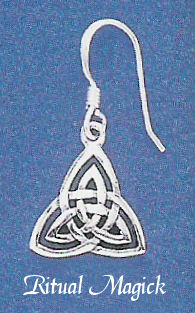 Example of a sterling silver triquerta earring (one of a pair, 3/4" in length) that can be used for Celtic knot magick. Charge the magick through either Druidic (Celtic) or Wiccan (modern Witchcraft) methods. Image courtesy of Ritual Magick (see earrings page).
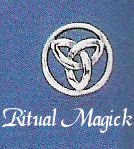 Example of a sterling silver triquerta ear stud (one of a pair, each 1/2" diameter) that can be used for Celtic knot magick. Charge the magick through either Druidic (Celtic) or Wiccan (modern Witchcraft) methods. Image courtesy of Ritual Magick (see earrings page).
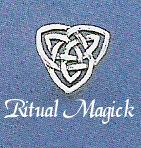 Example of a sterling silver interlaced triquerta ear stud (one of a pair, each 1/2" diameter) that can be used for Celtic knot magick. Charge the magick through either Druidic (Celtic) or Wiccan (modern Witchcraft) methods. Image courtesy of Ritual Magick (see earrings page).
The classic Wiccan method for cleansing and magickally charging a piece of jewelry is to place it under the light of the Full Moon. This can be done through the glass of a window (to avoid leaving jewelry unaccompanied outdoors where it might be stolen).
Magick pendants can be worn around the neck on either metal chains or natural twine.
Sterling silver is a great choice for magick jewelry. Magick jewelry should only be hung on goldne chains if the magick jewelry is used alone or with a trusted group (such as a coven). Gold absorbs energy and can take on the negative energy of strangers if worn in public.
Hemp twine is an excellent choice for magick pendants and jewelry. Organic hemp twine is best. The color of the hemp twine should match the magick.
color correspondences:
- White: Purity, peace and spirituality
- Black: Banishing, protection from negativity
- Gray: Balance, walking between two worlds
- Brown: Stability, home and hearth
- Red: Passion, strength, courage
- Yellow: Study, intelligence, confidence
- Orange: Vitality, energy, sexuality
- Green: Wealth, prosperity, fertility
- Blue: Tranquility, intuition, healing
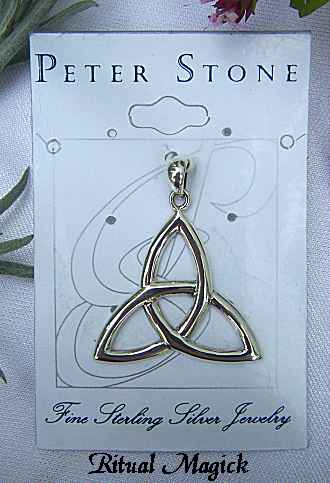 Example of a sterling silver triquerta kmot pendant (1-1/2" in length) that can be used for Celtic knot magick. Charge the magick through either Druidic (Celtic) or Wiccan (modern Witchcraft) methods. Image courtesy of Ritual Magick (see pendants and medallions page).
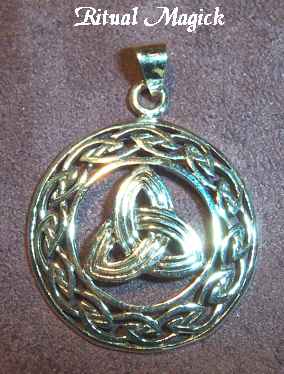 Example of a sterling silver triquerta pendant (1-1/2" in length) that can be used for Celtic knot magick. Charge the magick through either Druidic (Celtic) or Wiccan (modern Witchcraft) methods. Image courtesy of Ritual Magick (see pendants and medallions page).
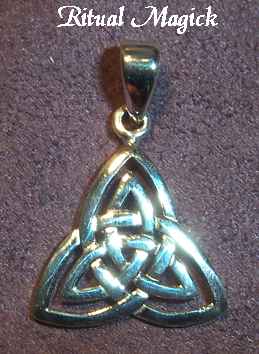 Example of a sterling silver triquerta pendant (1" in length) that can be used for Celtic knot magick. Charge the magick through either Druidic (Celtic) or Wiccan (modern Witchcraft) methods. Image courtesy of Ritual Magick (see pendants and medallions page).
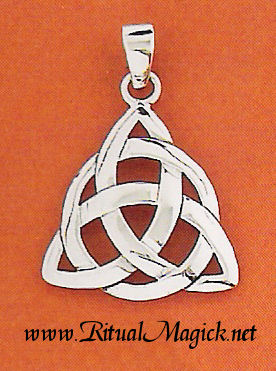 Example of a sterling silver triquerta pendant (1-1/2" in length) that can be used for Celtic knot magick. Charge the magick through either Druidic (Celtic) or Wiccan (modern Witchcraft) methods. Image courtesy of Ritual Magick (see pendants and medallions page).
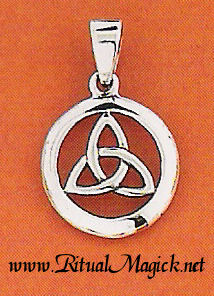 Example of a sterling silver triquerta pendant (1" in length) that can be used for Celtic knot magick. Charge the magick through either Druidic (Celtic) or Wiccan (modern Witchcraft) methods. Image courtesy of Ritual Magick (see pendants and medallions page).
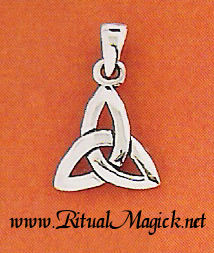 Example of a sterling silver triquerta pendant (3/4" in length) that can be used for Celtic knot magick. Charge the magick through either Druidic (Celtic) or Wiccan (modern Witchcraft) methods. Image courtesy of Ritual Magick (see pendants and medallions page).
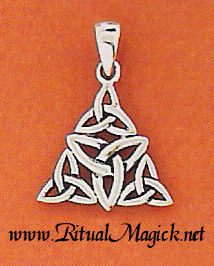 Example of a sterling silver triquerta pendant (1" in length) that can be used for Celtic knot magick. Charge the magick through either Druidic (Celtic) or Wiccan (modern Witchcraft) methods. Image courtesy of Ritual Magick (see pendants and medallions page).
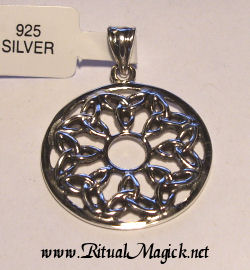
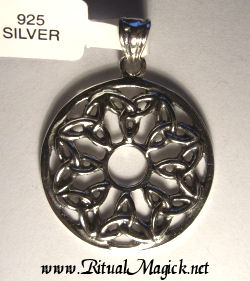
Example of a sterling silver triquerta knot pendant (1" in length) that can be used for Celtic knot magick. Charge the magick through either Druidic (Celtic) or Wiccan (modern Witchcraft) methods. Image courtesy of Ritual Magick (see pendants and medallions page).
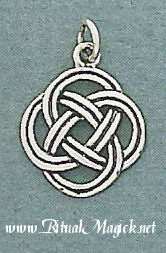 Example of a sterling silver Celtic Knot pendant (3/4" in length) that can be used for Celtic knot magick. Charge the magick through either Druidic (Celtic) or Wiccan (modern Witchcraft) methods. Image courtesy of Ritual Magick (see pendants and medallions page).
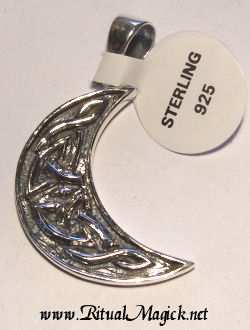 Example of a sterling silver Celtic Knot Moon pendant (1" in length) that can be used for Celtic knot magick. Charge the magick through either Druidic (Celtic) or Wiccan (modern Witchcraft) methods. Image courtesy of Ritual Magick (see pendants and medallions page).
See also the section on the history of Celtic knots.
| examples of hemp twine | ||
|---|---|---|
| may be purchased from HempStar | ||
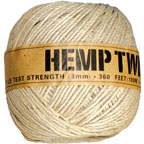
Ball of Twine - 3.0MM |
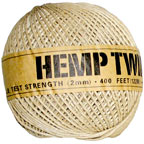
Hemp Twine - 2.0MM |
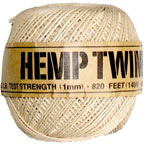
Ball of Twine - 1.0MM |
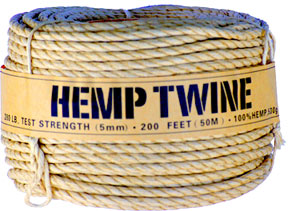
Twine/Rope - 5.0MM |
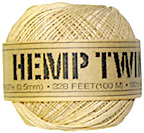
Ball of Twine - 0.5MM |
Color/Combo - 1.0MM |










 using
using  .
.