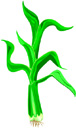
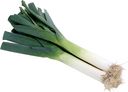
Botanical name:Allium ampeloprasum or Allium porrum
Common name: leek
French name: poireau
Use the botanical name when ordering seeds (bulbs, etc.) or when looking up information in the library. Common names vary by nation, culture, and region, and sometimes the same common name is applied to different plants.
origin:
Origin: Asia
history:
History: Leeks were popular in ancient Egypt.
nutritional information:
nutritional value per 100 grams:
Calories: 43 calories
Water: 85%
Proteins: 2.2 grams
Fat: 0.3 grams
Carbohydrates: 12 grams
high in folic acid
high in iron
high in potassium
Boiled leeks are high in manganese, vitamin C, iron, folate, and vitamin B6 (pyridoxine), while being low in calories.
When eaten raw the leek also contains calcium, copper, magnesium, Vitamin B6, and Vitamin C.
Leeks are a food that increases sexual energy and enhances fertility.
See also Chinese herbalism below for Chinese gender and Chinese flavor.
storage:
Storage: Eat leeks within a week (seven days) of purchase.
Free lessons on Witchcraft, ancient Goddesses, astrology, and nutrition. I will answer short questions on-line through TeenWitchdotcom at Twitter and in person in the Costa Mesa/Newport Beach area. I will teach you what you need to know to be a successful priest, priestess, or witch, including the ability to perform weddings and readings. For more information read Witchcraft lessons.
private and small group lessons
Contact Milo for information on private and small group lessons in Costa Mesa and Newport Beach, California. Tutoring in Witchcraft, chess, guitar, English grammar and writing, history, or computer programming. Low cost or free for the poor. Recommended donation of $25 an hour (or $15 for half an hour). Minors need written permission from parent or guardian. Send a self-addressed stamped envelope to: Milo, PO Box 1361, Tustin, California, USA, 92781.
Contact Teen Witch at Milo, PO Box 1361, Tustin, California, USA, 92781 (please include a self-addressed stamped envelope for any reply). My computer is broken, so I can’t send or receive e-mail.
These web pages are about witchcraft. Attempting to be an amateur doctor is potentially dangerous to your health. These web pages are not professional medical and/or legal advice. Nothing on this website should be considered as a substitute or replacement for professional legal and/or medical advice. Persons should seek the advice of qualified health and/or legal providers.
Recommended professional health providers in southern California: ayurveda, chiropractic, and yoga.
If you spot an error in fact, grammar, syntax, or spelling, or a broken link, or have additional information, commentary, or constructive criticism, please contact Milo the Witch at PO Box 1361, Tustin, California, USA, 92781.


 Love, Protection, Exorcism














 using
using  .
.