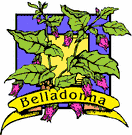
Use the botanical name when ordering seeds (bulbs, etc.) or when looking up information in the library. Common names vary by nation, culture, and region, and sometimes the same common name is applied to different plants.
magickal correspondences and uses:
Gender:feminine (traditional western European magickal gender)
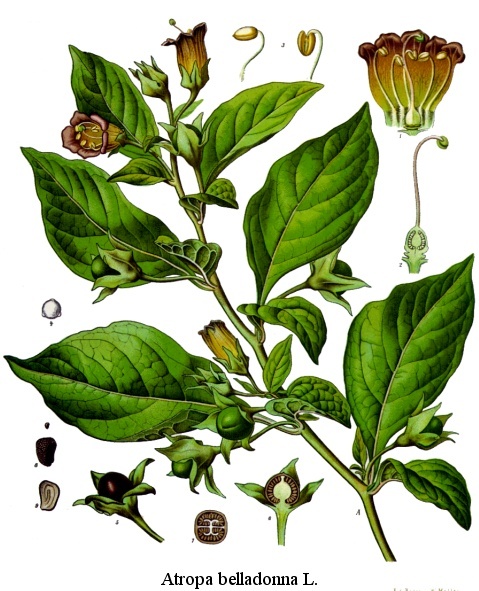
Magickal uses: Used in medieval flying ointments (symptoms of belladonna poisoning include vivid hallucinations and a sense of flying).
Magickal substitutions:Rosemary usually may be safely substituted for any herb in magick spells and rituals. Roses may safely be substituted for any flower.
Magical Uses astral projection (DEADLY POISON!)
information courtesy of
ancient myths and beliefs:
Religious uses: Roman soldiers used belladonna (which they called bellona) to create a battle frenzy. Priests of the Roman Goddess Bellona (wife, sister, or daughter of Mars) used belladonna in religious rituals. Bellona represented the frenzy of battle.
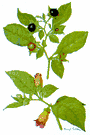
Cautions and contraindications: Belladonna is one of the most toxic plants in the Western hemisphere. A few berries or a leaf can kill. The root is the most toxic part. The toxin is tropane alkaloids. Symptoms of belladonna poisoning are the same as for atropine and include dilated pupils, tachycardia, hallucinations, blurred vision, loss of balance, feeling of flight, staggering, a sense of suffocation, paleness followed by red rash, flushing, husky voice, extreme dry throat, constipation, urinary retention, confusion, and death. The antidote is physostigmine or pilocarpine. Belladonna can kill pets and livestock.
Some herbs may be poisonious under some conditions. Exercise appropriate care.
Wild gathering: Avoid wild gathering. Some plants are endangered species. Some plants can be toxic just by touch. Even experts can make deadly misidentifications of wild plants. Please grow your own herbs in your own goddess garden (or window boxes).
Free lessons on Witchcraft, ancient Goddesses, astrology, and nutrition. I will answer short questions on-line through TeenWitchdotcom at Twitter and in person in the Costa Mesa/Newport Beach area. I will teach you what you need to know to be a successful priest, priestess, or witch, including the ability to perform weddings and readings. For more information read Witchcraft lessons.
private and small group lessons
Contact Milo for information on private and small group lessons in Costa Mesa and Newport Beach, California. Tutoring in Witchcraft, chess, guitar, English grammar and writing, history, or computer programming. Low cost or free for the poor. Recommended donation of $25 an hour (or $15 for half an hour). Minors need written permission from parent or guardian. Send a self-addressed stamped envelope to: Milo, PO Box 1361, Tustin, California, USA, 92781.
Contact Teen Witch at Milo, PO Box 1361, Tustin, California, USA, 92781 (please include a self-addressed stamped envelope for any reply). My computer is broken, so I can’t send or receive e-mail.
These web pages are about witchcraft. Attempting to be an amateur doctor is potentially dangerous to your health. These web pages are not professional medical and/or legal advice. Nothing on this website should be considered as a substitute or replacement for professional legal and/or medical advice. Persons should seek the advice of qualified health and/or legal providers.
Recommended professional health providers in southern California: ayurveda, chiropractic, and yoga.
If you spot an error in fact, grammar, syntax, or spelling, or a broken link, or have additional information, commentary, or constructive criticism, please contact Milo the Witch at PO Box 1361, Tustin, California, USA, 92781.

 astral projection









 using
using  .
.